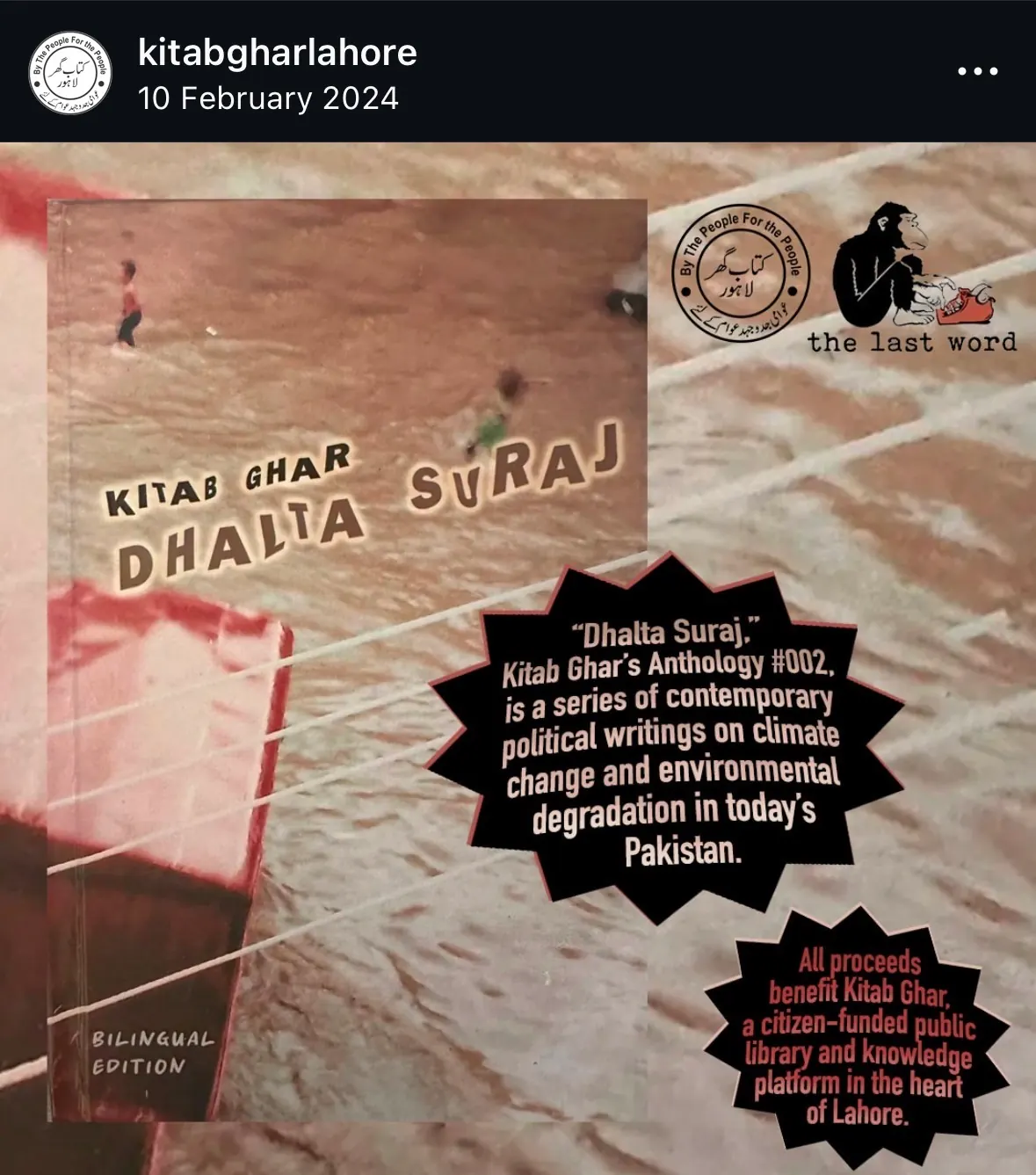
Kitab Ghar Presents
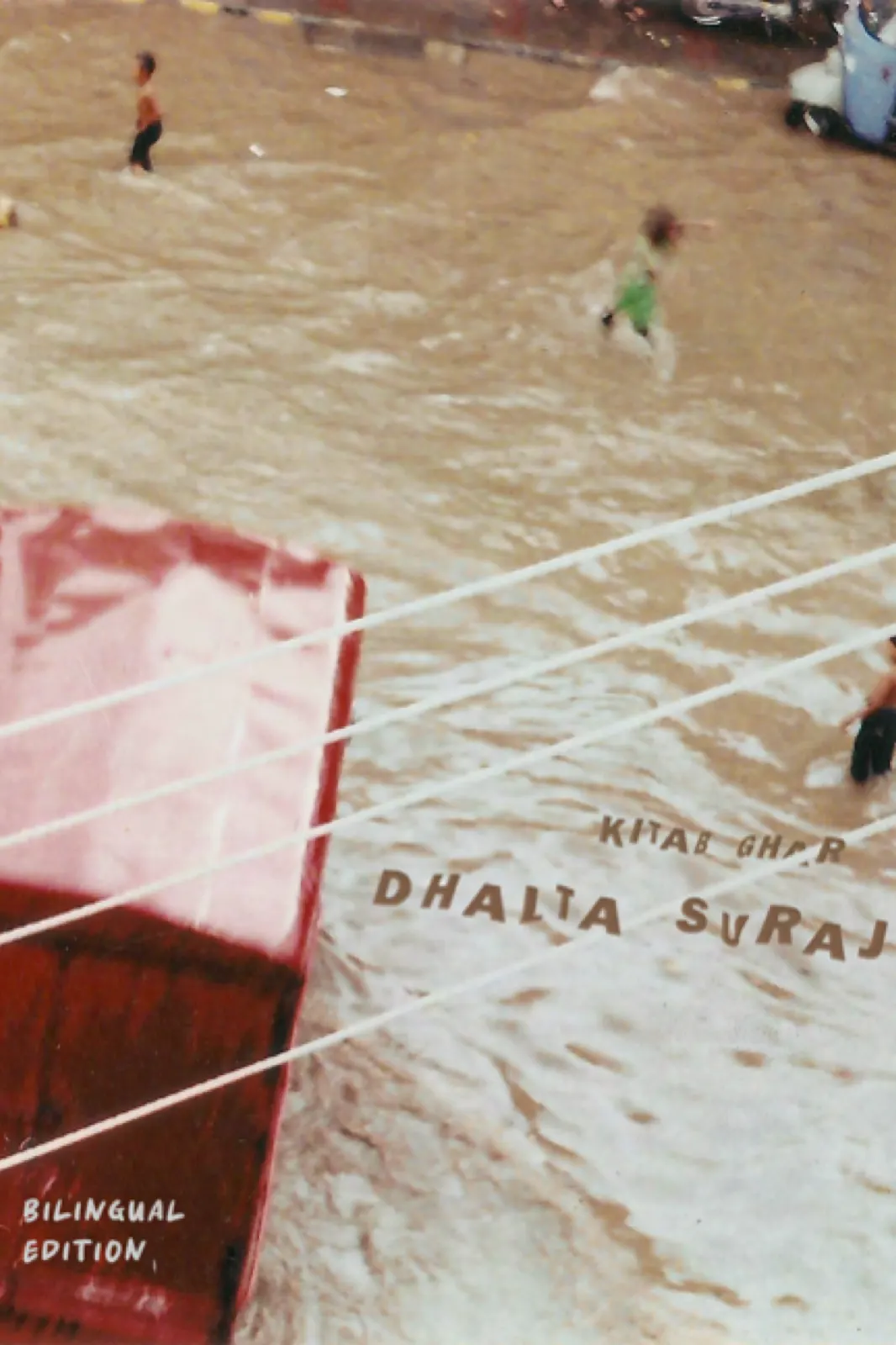
Dhalta
Suraj
Contemporary political writings on climate change and environmental degradation in today's Pakistan.
By 2050, climate change could claim nearly 250,000 lives per year and displace more than 140 million people. That's 684 lives taken every day.
10
Contributors
3
Languages
#002
Anthology
May these perspectives inspire action! I believe you will find this anthology both practical and emotionally resonant. These narratives are an invitation to connect with the issue of climate change on a personal level and make climate friendly choices. Perhaps, reading and writing can help us better understand the changing world, and help us take responsibility, gain resilience, and build practices of mutual aid.
Sagar Shabbir
Chief EditorThis anthology compels us to confront our individual responsibilities in the face of climate change. To ensure a wider readership, the pieces have been translated into Urdu. From the 2022 monsoon floods that left one-third of Pakistan underwater, to the endangered Indus River Dolphin, to lead-poisoned children in Lahore's industrial neighborhoods — these are not distant problems. They are dispatches from the frontline.
The Essays
10 voices. 2 languages.
One crisis.
Activists, lawyers, artists, students, and researchers from across Pakistan — each confronting climate change from where they stand.
Afia Salam
Journalist & Climate Activist
Climate Change is Everybody's Business
“Pakistan has a very negligible share in the devastation caused by Climate Change, as its emissions hardly make up even 1% of global emissions. Yet it ranks among the top ten vulnerable countries in the Global Vulnerability Index.”
Sadia Khatri
Writer & Researcher
Notes from Badin: Not a Natural Disaster
“They looked like lakes. But no, that was stillwater. Standing water from the "unprecedented" monsoon floods. Highways in Sindh submerged, road signs swimming in some new ocean. 'Sehwan', a sign pointed to nowhere.”
Ahmed Rafay Alam
Environmental Lawyer & Activist
Survey of Environmental Law of Pakistan
“Pakistan's first major environment case was filed in the name of a feminist. Shehla Zia was the founder of Pakistan's first all-woman law firm. It wasn't until 1994 that environmental rights attained the status of fundamental rights.”
Zulfikar Ali Bhutto Jr
Artist & Wildlife Activist
Daku River Dolphin
“Within seconds a young bulhan jumps full body out of the water, it felt like a unicorn had just galloped across the surface of the river, we can't believe our eyes. I write our first sighting in the data sheet and shed a tear as I do so.”
Areeba Fatima
Co-Founder, Kitab Ghar
Chronicles of a Wasteland
“Dr. Nausheen Zaidi's team conducted a study with 200 residents — 36% of pregnant women were reporting stillbirths and 52% of the residents were anemic. The lead levels in Sharifpura's groundwater exceed WHO limits by 155x.”
Zuha Amjad
Student & Climate Activist
Karachi Bachao!
“Urban flooding has become a frequent occurrence rather than an unfamiliar or sporadic event. The government has resorted to carrying out forced evictions with a meager compensation of Rs 15,000 per month.”
Sherdil Rashid
Writer
Some of Them Were Trees
“When did the metallic and inescapably cyclical demands of capitalism and technology close over our heads and sever the threads connecting ourselves to nature, threads that have been so tightly wound around us ever since humanity began?”
Asad Ali Zulfiqar
Writer
Story Translation
“A translated story that highlights the consequences of forgetting one's bond with the earth.”
Pirah Aijaz
Writer
UrduWomen & Climate Change
“On how climate change disproportionately affects women — their health, education, economic independence, and physical safety — and the urgent need for a comprehensive approach.”
Abuzar Madhu
Poet
PunjabiPoetry on the Ravi River
“Punjabi poetry contemplating the Ravi — its foul smell not merely an external problem, but a spiritual decay within humanity itself. "This is an inner smell."”
The Indus River Dolphin is a symbol of the fragility of the Indus itself. Dolphins are the canaries in the coalmine of Pakistan — if they are not reproducing it means they are not healthy and if that is the case it means the quality of water in the Indus is going down. Rivers will not provide infinitely; they have their limits and the Indus is reaching its breaking point.
Zulfikar Ali Bhutto Jr
Daku River Dolphin
Chief Editor
Sagar Shabbir
Translator
Waqas Hafeez
Art Director
Nabeel Naveed
They promise, several women said. They take photos, they say they'll come back with relief, but no one shows up. An unfathomable number of people displaced countrywide — and still, the first rule of helping other humans was: check what religion that human belongs to.
Sadia Khatri
Notes from Badin: Not a Natural Disaster
Every copy keeps a free library open
Reading as resistance.
Dhalta Suraj was produced and published by Kitab Ghar, Lahore. All proceeds go directly to keeping the library doors open and the books free.