Customer discovery
How I Did Customer Discovery for Articulate
How Articulate started, what it was before, and the moment in San Francisco that made me build it.
I figured out what I was building on a winter trip to San Francisco, standing in a room with people who work at Google, unable to finish a sentence. I had been spending a lot of time around founders building ambitious things, and it did something to me. It made me want to build something too.
Someone asked me the easiest question in the world. "So, what do you do?" And I mumbled. I knew exactly what I did. I had built things, taught, and shipped. But between the answer in my head and the words that made it into the room, something fell apart. I filled the gaps with "umm." I watched myself sound less capable than I actually was, and I couldn't stop it.
I left that conversation with one thought: I am not stupid, I am just unpracticed at this exact thing. And it is not only me. A lot of very capable people lose the opportunity in front of them because they do not know how to speak in the one moment they have someone's full attention. Nobody teaches you this. You get graded on essays and exams for twenty years, then you are dropped into a networking event and expected to be fluent, warm, and clear on demand. The people who win those rooms are almost never the ones with the best work. They are the ones who can make you understand it.
That was the seed. Here is what actually grew from it.
Where I was coming from
I did not take the normal path. I took multiple gap years, off the standard timeline, on purpose. Before university I worked full time at Kitab Ghar and App Rays, then taught mobile app development at LUMS, the Lahore University of Management Sciences. I moved countries to study in Canada at the University of Alberta, then to Toronto to take this further.
Somewhere in there I kept noticing the same thing about myself. I could do the work. I could not always explain it. In interviews, in introductions, in "so what brings you here" small talk, I sounded like a smaller version of the person I actually was.
Once I saw it in myself, I saw it everywhere. Smart students who froze in interviews. Immigrants who spoke three languages and still got underestimated in the fourth. Third culture kids who could code a product but not pitch it. These are not people with nothing to say. They have a translation problem between what they know and what comes out of their mouth in the moment they need it most.
I will be honest about my own stakes, because it is part of why I care. I am from Pakistan-administered Kashmir. I was refused a visa three times. A lot of my life has been spent trying to convince a room, a border, an interviewer, that I am worth taking seriously, often in a language and a setting that was not built for me. When I say communication changes outcomes, I do not mean it as a slogan.
I have lived on the wrong side of a conversation I could have won.
What Articulate was before
The first version, at the end of December 2025, was not the app you see today. It was closer to a "public speaking gym and charisma lab," a cheaper, always-available answer to those thousand-to-five-thousand-dollar speaking courses.
It was an eight week curriculum: energy and presence, delivery, something I called "alert nonchalance," conversational weaving. You would record a thirty, sixty, or ninety second answer and get scored on filler words, pacing, content, and delivery. Foundation first, technique later.
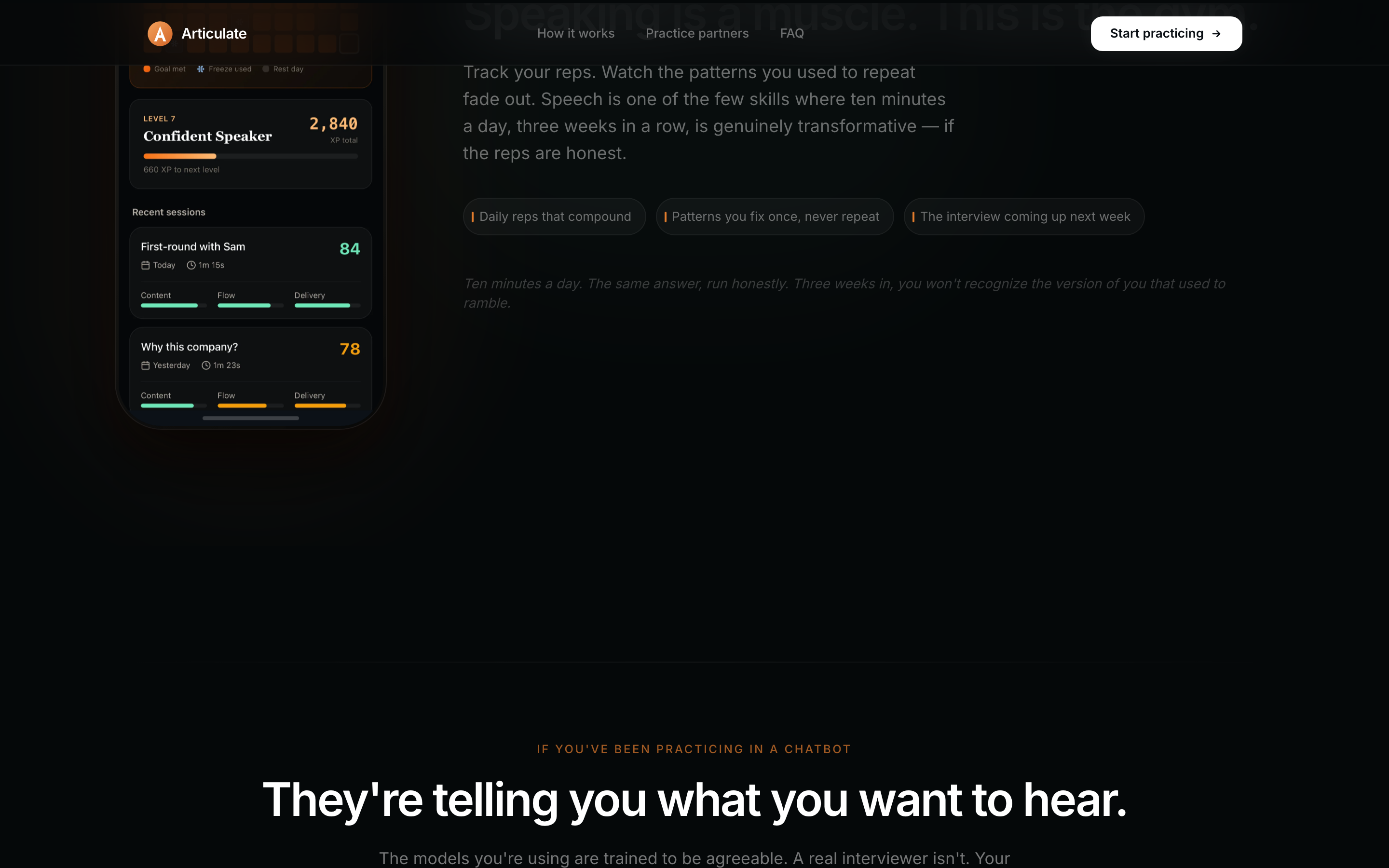
I still love that version. But it had a problem I could not out-design: it was for everyone, which meant it was for no one in particular. "Become a more articulate professional" is a beautiful mission and a terrible wedge. When I put it in front of real people, they nodded politely and did not come back. It was the answer to a question most people had not admitted they were asking yet.
Learning it in a real room
At the University of Alberta, which has one of the strongest drama programs in Canada, I signed up for a public speaking class. The instructor was excellent and pushed me well out of my comfort zone: real techniques, real reps, a little discomfort every week. I walked out of almost every class with something I could fold straight back into Articulate. The product kept getting better because I was getting better.
That is also when I stopped defending the vision and started following the people who actually used it.
The interview is the wedge
The one moment everyone recognized was the interview. Not "public speaking" in the abstract, the specific dread of a question you should be able to answer and somehow cannot.
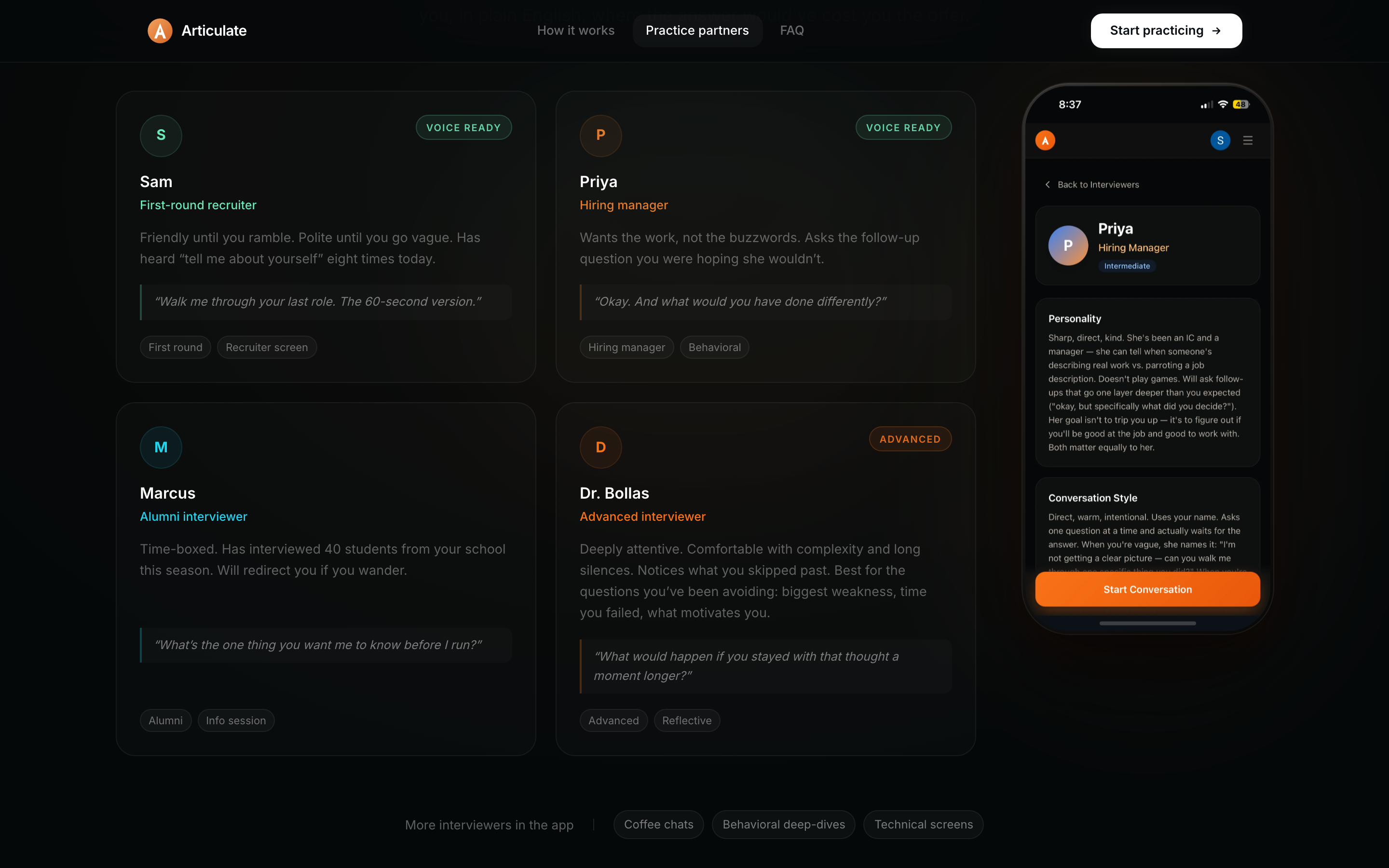
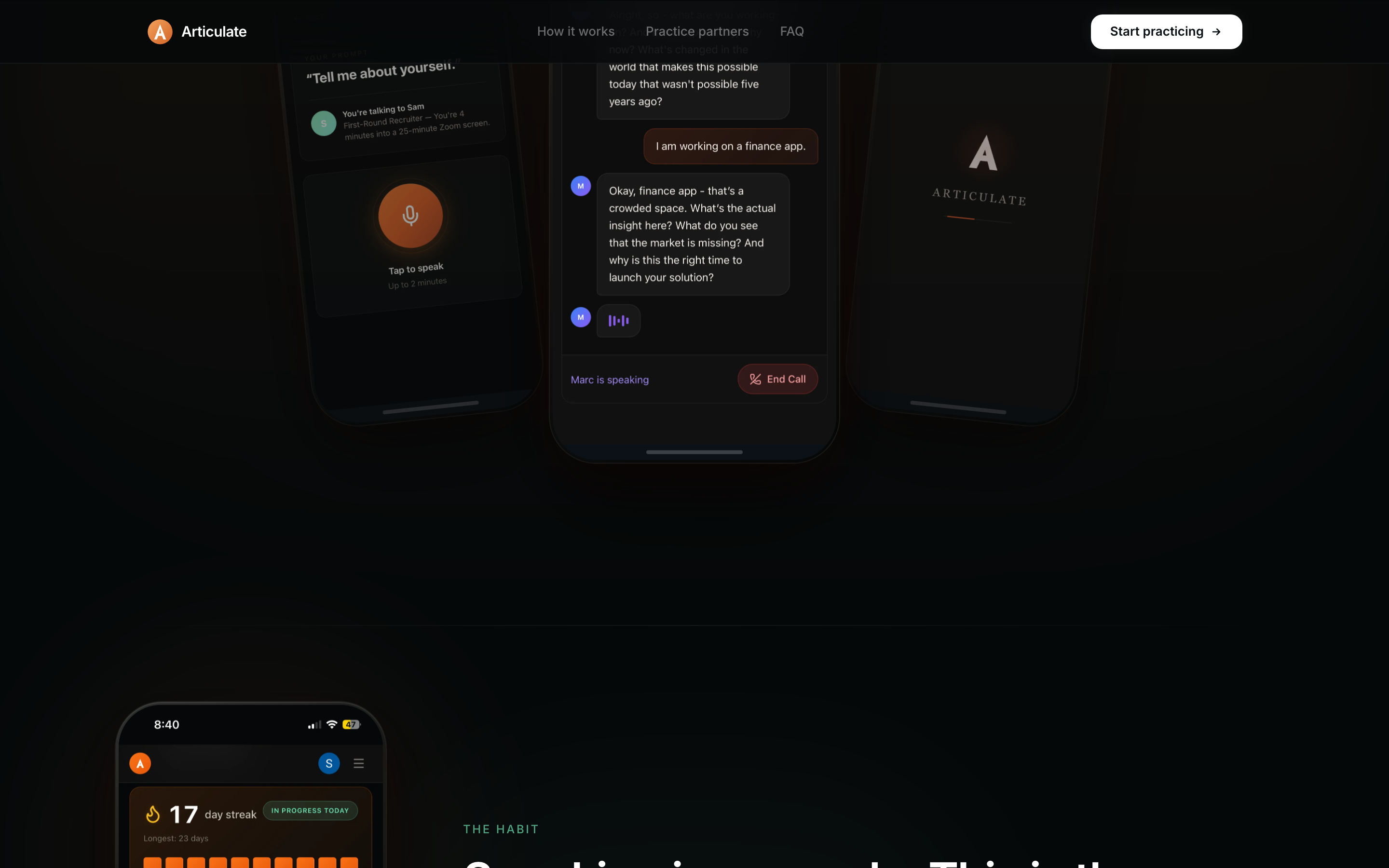
So I built voice personas that behave like real interviewers. They ask, they follow up, and they push back when you ramble instead of politely waiting, the way a hiring manager who has heard the rehearsed answer a hundred times would. The goal was to make practice feel like the real room, with the stakes turned down.
Making it feel real
Early on the voices were generic and it broke the spell. An ElevenLabs startup grant let me switch to genuinely human sounding voices, and the whole thing changed character. It was the first time testers called it stressful, which was exactly the point. Realism was not a polish item. It was the mechanism. Practice only works when your body believes the stakes are real.
The pattern was bigger than students
For a while I aimed the whole thing at students and job-seekers, because that is where interview pain is sharpest and where I came from. But the story I told and the people who actually showed up were not the same market, and I had been listening to the story. The ones who kept using it were wider: a software engineer in Ireland who gave me the deepest feedback I got, a friend testing it in Finnish who said the suggestions were good even in a language I never designed for, coaches in Toronto who used it as between-session practice for their own clients. They were all pointing at the same thing. This was about any high-stakes moment in front of another person, not one demographic.
Where the real signal showed up: creators
I had moved to Toronto partly to chase some personal projects, and I ended up close to the creator world: fashion, acting, modelling, and doing some of it myself. The more time I spent in it, the more obvious it became how much people there need voice and camera training. For a creator, being good on camera is not a nice-to-have. It is tied directly to their income.
So I stopped guessing and went to talk to them. I reached out to creators directly and got on the phone with almost fifty of them. Most of them loved the idea, and I now have a group of early users who want to test the product. That is the strongest signal Articulate has had so far, and it is the direction I am building toward now.
What it actually is now
Underneath every pivot, the product has been one thing the whole time: a place to practice the moments that matter out loud, before they happen, with something that talks back and tells you how you actually sounded.
The name is the thesis. To articulate is to close the distance between what you mean and what you manage to say. Everyone sounds better in their head. My job is to make the out-loud version catch up.
I am building this solo, from Toronto, bootstrapped, one revision at a time. If you have ever walked away from a conversation thinking "I know I'm better than that," whether the next room is an interview or a camera, this was built by someone who has walked away from a lot of them.